
BLOG

- Home
- Blog
- Plastic Polymer Composite Article
- Role of CaCO₃ Powder in SPC Flooring Production
Role of CaCO₃ Powder in SPC Flooring Production
October 07,2026
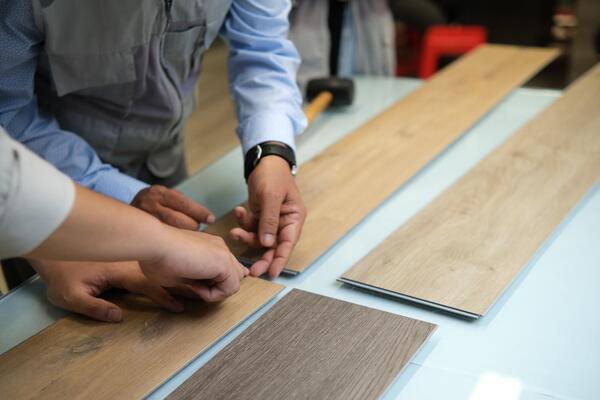
CaCO₃ powder is a component that makes up a large proportion of the composition of SPC flooring, directly determining the product's hardness, load-bearing capacity, dimensional stability, and service life. Besides optimizing production costs, this raw material also helps SPC flooring resist warping, resist water, and improve processing efficiency.
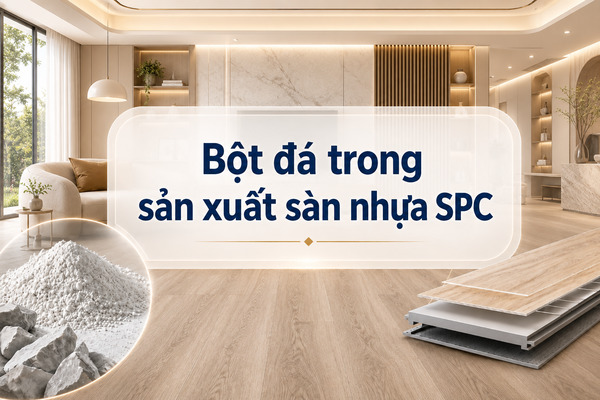
Role of CaCO₃ Powder in SPC Flooring Production
The Role of CaCO₃ Powder in SPC Flooring Production
CaCO₃ powder brings many benefits to the production process and determines the final quality of SPC flooring.
Increasing Hardness and Dimensional Stability
CaCO₃ powder acts as the "backbone" of the SPC flooring core. When blended with virgin PVC resin, the CaCO₃ particles fill the gaps in the polymer structure, creating a dense, solid structure and increasing load-bearing capacity.
As a result, SPC flooring can withstand heavy loads from beds, cabinets, tables, chairs, or heavy furniture without denting or deforming. At the same time, the flooring core always maintains a stable flatness, providing a solid foundation for the wood-grain film layer and the anti-scratch coating on top.
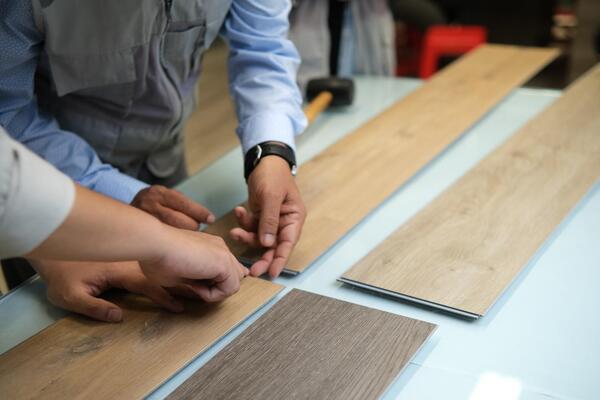
CaCO₃ powder increases hardness for SPC flooring
Reducing Shrinkage and Preventing Warping
PVC resin tends to expand when the temperature changes. Without a suitable proportion of added CaCO₃ powder, the flooring will easily warp or shrink after a period of use.
CaCO₃ powder has a very low thermal expansion coefficient, which helps fix the flooring core structure and minimize deformation caused by weather conditions. As a result, SPC flooring does not bulge when the temperature rises or develop gaps when the weather turns cold.
Dimensional stability also helps the locking system (Click System) remain tightly connected, limiting shifting or unlocking after many years of use.
Improving Processing Capability
During production, CaCO₃ powder also helps optimize the operating efficiency of the extrusion line.
The CaCO₃ particles act as a heat-distribution agent, helping heat spread evenly throughout the molten resin mixture. This reduces resin scorching, air bubbles, and surface pitting.
In addition, an appropriate ratio of CaCO₃ powder also helps the SPC sheet achieve high flatness after leaving the press mold, supporting a sharp, precise milling process for the locking grooves and limiting frayed edges or cracking.
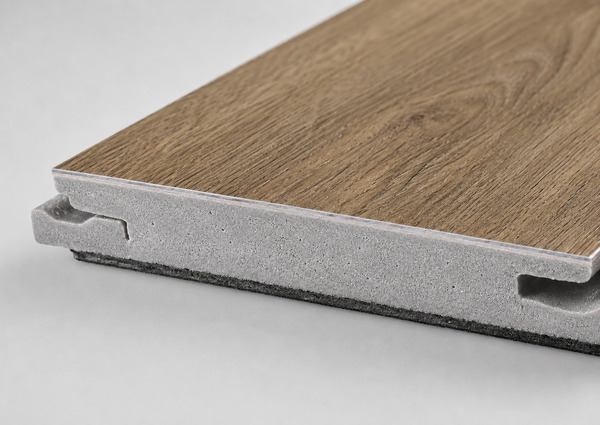
CaCO₃ powder helps SPC sheets achieve high flatness, limiting frayed edges or cracking
Optimizing Raw Material Costs
Virgin PVC resin is a relatively expensive raw material. Meanwhile, CaCO₃ powder has an abundant supply and a significantly lower cost.
Using CaCO₃ powder in the right proportion helps reduce the amount of resin needed while still ensuring product quality. This helps businesses lower the cost per square meter of flooring and increase their competitiveness in the market.
In addition, CaCO₃ powder also helps absorb stabilizers and processing aids effectively, helping to optimize the amount of additives in the production formula.
Enhancing Product Durability
CaCO₃ powder helps enhance the mechanical lifespan of SPC flooring, keeping the flooring core less prone to aging, becoming brittle, or degrading in quality over time.
Because CaCO₃ does not absorb water at all, SPC flooring has outstanding water resistance and does not swell or develop mold like engineered wood flooring.
In addition, calcium carbonate also has good heat resistance and is non-flammable, helping SPC flooring meet fire-spread-resistance standards such as Bfl-s1 in many modern construction applications.
Factors That Determine the Quality of CaCO₃ Powder for SPC Flooring
Not every type of CaCO₃ powder is suitable for SPC flooring production. To ensure product quality, businesses need to pay attention to the following criteria:
- CaCO₃ content: Purity should reach 98% or higher to limit impurities and increase bonding capability with PVC resin.
- Whiteness and brightness: CaCO₃ powder with a whiteness of 95-98% helps the flooring core have a naturally bright color, making it easier to color-match and enhancing the aesthetics of the finished product.
- Impurity content: The content of iron oxide (Fe₂O₃) and aluminum oxide (Al₂O₃) needs to be controlled below 0.05% to avoid discoloring the resin or affecting the extrusion process.
- Particle size: For SPC flooring, the common d50 is 2-5 µm (approximately 1200-2500 mesh). Particles that are too large easily scratch equipment, while particles that are too fine can cause clumping and affect dispersion capability.
- Stearic acid coated powder: CaCO₃ powder should be surface-treated with stearic acid to increase compatibility with PVC resin, helping the mixture disperse evenly and enhancing the product's mechanical strength.
- Low moisture content: Moisture must be controlled below 0.2%. If the CaCO₃ powder is damp, water vapor will form during extrusion, causing air bubbles and reducing the quality of the flooring core.
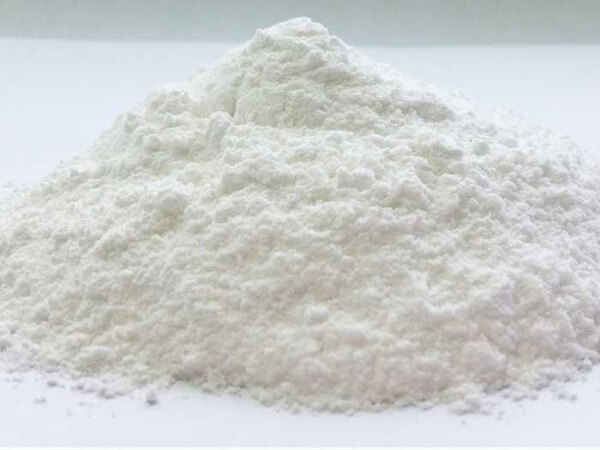
Factors that determine the quality of CaCO₃ powder for SPC flooring
How Does the Content of CaCO₃ Powder Affect SPC Flooring?
The proportion of CaCO₃ in the SPC flooring core needs to be calculated accurately to achieve a balance between hardness and flexibility.
- 65-75%: The ideal ratio helps flooring achieve high hardness, good load-bearing capacity, and a durable locking system.
- Above 80%: The flooring core becomes too brittle, easily cracking or breaking during transport or installation, while also increasing wear on production equipment.
- Below 60%: The flooring core lacks hardness, easily shrinks and warps when the temperature changes, and also increases costs due to the need for more PVC resin.
Criteria for Selecting CaCO₃ Powder for SPC Flooring Production
In addition to technical specifications, businesses need to evaluate the raw material's practical suitability for their production formula and production line.
- Compatibility with the production formula: CaCO₃ powder needs to meet the requirements for hardness, toughness, locking-groove cutting capability, and blending ratio of each SPC flooring line.
- Consistency between batches: Fineness, whiteness, moisture, and coating-level metrics need to be maintained consistently to limit the need for frequent extruder adjustments.
- Quality control documentation: Suppliers should provide a Certificate of Analysis (COA) for each batch, along with test samples and clear technical information so businesses can easily verify quality before large-scale production.
- Supply capability: The raw material source needs to be stable in terms of output volume, delivery time, and packaging specifications, especially for factories operating continuously.
- Technical support: Suppliers capable of advising on product-code selection and coordinating trial runs will help reduce risk when changing raw materials.
APEX Vietnam - A Trusted Supplier of CaCO₃ Powder for the SPC Flooring Industry
APEX Vietnam is a unit that supplies high-quality CaCO₃ powder to many businesses manufacturing plastics and construction materials.
The raw material source is mined from high-purity white limestone quarries in Vietnam, combined with modern ultra-fine grinding technology and stearic acid coating. As a result, the product always meets strict requirements for CaCO₃ content above 98%, high whiteness, moisture below 0.2%, and stable particle size.
With large production capacity and a strict quality control system, APEX Vietnam meets the stable supply needs of domestic SPC flooring manufacturers as well as export markets.
If your business is looking for CaCO₃ powder for SPC flooring production with consistent quality and large supply capacity, contact VNAPEX via hotline +84 274 362 0911 for product advice tailored to your specific production formula.