
NEWS & EVENTS

- Home
- News
- Products Information
- PP Plastic Injection Molding: Things You Should Remember to Ensure Product Quality
PP Plastic Injection Molding: Things You Should Remember to Ensure Product Quality
June 20,2026
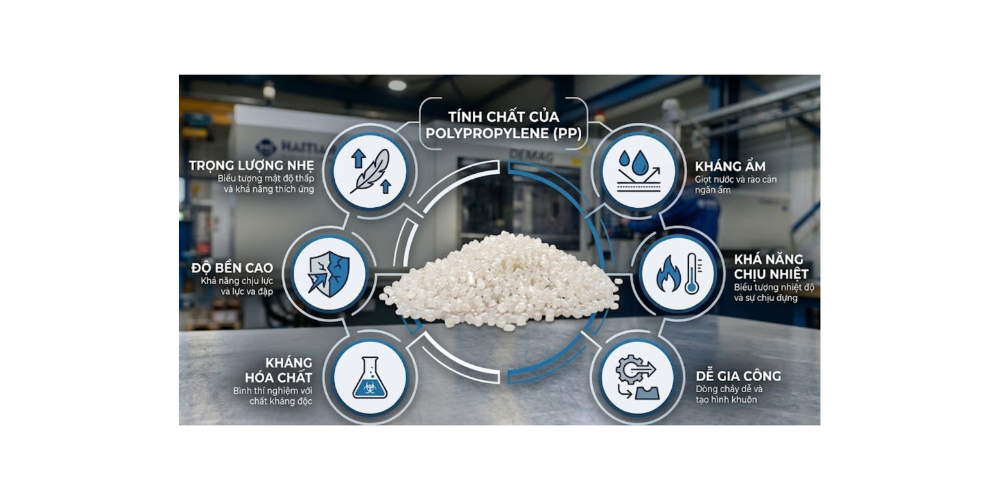
Polypropylene (PP) is one of the most widely used thermoplastics today due to its reasonable cost, high durability, and diverse applications. In the plastics manufacturing industry, PP injection molding is considered an efficient processing method, helping to create products with high precision and stable productivity. However, to achieve optimal product quality, businesses need to understand the important factors in the production process.
Understanding the properties of PP plastic
PP is a semicrystalline material with a melting point of approximately 160–170°C. Its outstanding characteristics include good flowability, high chemical resistance, and light weight. However, PP also has a relatively high shrinkage rate, typically ranging from 1–2.5%, which can easily lead to warping if processing parameters are not properly controlled.
Furthermore, each type of PP, such as PP Homopolymer, PP Random Copolymer, or PP Impact Copolymer, possesses its own unique properties. Choosing the right raw materials and additives directly impacts the quality of the final product.
Prepare the ingredients properly.
Although PP is not as hygroscopic as some other engineering plastics, the raw material still needs to be stored in a dry, clean environment. For PP plastics that have been stored for a long time or contain fillers such as talc powder, drying before processing can help reduce surface defects and improve product stability.
In addition, businesses need to pay special attention to contamination. Even a small amount of mixed material can cause defects, reduce mechanical strength, and affect the aesthetics of the product.
Optimizing injection molding parameters
Temperature control
Melting temperature is a crucial factor determining mold filling ability and product quality. Typically, the processing temperature for PP is maintained between 200 and 230°C.
If the temperature is too low, the plastic will have difficulty melting and seams or material shortages may occur. Conversely, if the temperature is too high, the material may decompose, affecting color and mechanical properties.
Adjust the pressure and spray speed.
Injection pressure and holding pressure need to be set appropriately for each product type. Holding pressure typically ranges from 50-70% of the injection pressure to compensate for shrinkage during cooling.
High injection speeds allow for rapid filling of thin-walled products, but excessively high speeds can cause spraying or surface defects. Therefore, balancing speed and pressure is crucial to ensuring product quality.
Control the cooling process.
Uniform cooling helps limit uneven shrinkage and reduces the risk of warping. Mold temperatures are typically maintained between 20 and 60°C, depending on product requirements. A well-designed cooling system not only improves quality but also shortens production cycle times.
Common challenges encountered when injection molding PP
One of the most common problems is shrinkage and warping due to the crystalline properties of PP. To overcome this, it is necessary to optimize the injection gate position, design a uniform product wall thickness, and adjust the pressure holding parameters appropriately.
In addition, surface indentations often appear in areas with greater thickness. Businesses can minimize this by increasing the holding pressure, extending the holding time, optimizing the design of stiffening ribs, or reducing product thickness in necessary areas.
In general, PP injection molding is not simply a product shaping process but also a combination of material properties, mold design, and mold operation techniques. Good control of factors such as raw material quality, processing temperature, injection pressure, and cooling time will contribute to improving product stability, minimizing defects, and optimizing production efficiency.
In the dynamic and ever-evolving plastics industry, businesses need to constantly update their technology, improve processes, and accumulate practical experience to better meet market demands. This is also a crucial foundation for improving product quality, reducing costs, and increasing competitiveness in the long term.
Understanding the properties of PP plastic
PP is a semicrystalline material with a melting point of approximately 160–170°C. Its outstanding characteristics include good flowability, high chemical resistance, and light weight. However, PP also has a relatively high shrinkage rate, typically ranging from 1–2.5%, which can easily lead to warping if processing parameters are not properly controlled.
Furthermore, each type of PP, such as PP Homopolymer, PP Random Copolymer, or PP Impact Copolymer, possesses its own unique properties. Choosing the right raw materials and additives directly impacts the quality of the final product.
Prepare the ingredients properly.
Although PP is not as hygroscopic as some other engineering plastics, the raw material still needs to be stored in a dry, clean environment. For PP plastics that have been stored for a long time or contain fillers such as talc powder, drying before processing can help reduce surface defects and improve product stability.
In addition, businesses need to pay special attention to contamination. Even a small amount of mixed material can cause defects, reduce mechanical strength, and affect the aesthetics of the product.
Optimizing injection molding parameters
Temperature control
Melting temperature is a crucial factor determining mold filling ability and product quality. Typically, the processing temperature for PP is maintained between 200 and 230°C.
If the temperature is too low, the plastic will have difficulty melting and seams or material shortages may occur. Conversely, if the temperature is too high, the material may decompose, affecting color and mechanical properties.
Adjust the pressure and spray speed.
Injection pressure and holding pressure need to be set appropriately for each product type. Holding pressure typically ranges from 50-70% of the injection pressure to compensate for shrinkage during cooling.
High injection speeds allow for rapid filling of thin-walled products, but excessively high speeds can cause spraying or surface defects. Therefore, balancing speed and pressure is crucial to ensuring product quality.
Control the cooling process.
Uniform cooling helps limit uneven shrinkage and reduces the risk of warping. Mold temperatures are typically maintained between 20 and 60°C, depending on product requirements. A well-designed cooling system not only improves quality but also shortens production cycle times.
Common challenges encountered when injection molding PP
One of the most common problems is shrinkage and warping due to the crystalline properties of PP. To overcome this, it is necessary to optimize the injection gate position, design a uniform product wall thickness, and adjust the pressure holding parameters appropriately.
In addition, surface indentations often appear in areas with greater thickness. Businesses can minimize this by increasing the holding pressure, extending the holding time, optimizing the design of stiffening ribs, or reducing product thickness in necessary areas.
In general, PP injection molding is not simply a product shaping process but also a combination of material properties, mold design, and mold operation techniques. Good control of factors such as raw material quality, processing temperature, injection pressure, and cooling time will contribute to improving product stability, minimizing defects, and optimizing production efficiency.
In the dynamic and ever-evolving plastics industry, businesses need to constantly update their technology, improve processes, and accumulate practical experience to better meet market demands. This is also a crucial foundation for improving product quality, reducing costs, and increasing competitiveness in the long term.