
NEWS & EVENTS

- Home
- News
- Products Information
- What is the difference between plastic injection molding and plastic casting?
What is the difference between plastic injection molding and plastic casting?
May 19,2026
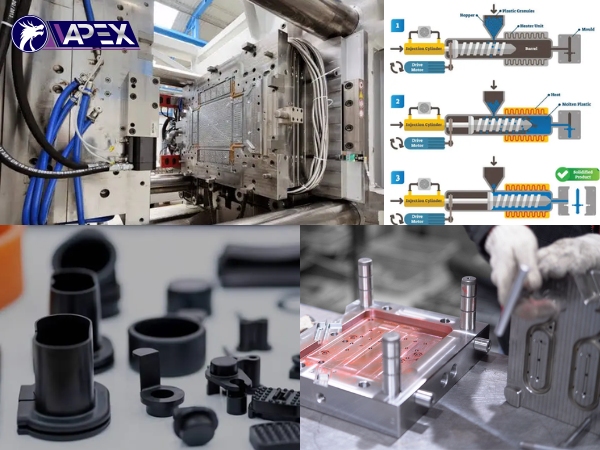
In real-world manufacturing, many businesses often confuse plastic injection molding and plastic casting when choosing a shaping technology. Although both use polymer materials, these two methods differ significantly in processing approach, investment cost, and product characteristics. Clearly distinguishing between these technologies from the beginning helps optimize production processes, reduce risks, and improve long-term manufacturing efficiency.
Overview of plastic injection molding technology
Plastic injection molding is a manufacturing method that uses high temperature and high pressure to melt plastic pellets, which are then injected into a metal mold to form precise products. This is the most widely used process for mass-producing complex plastic parts with high durability and a smooth surface finish.
Operating principle:
Raw plastic material is heated until it reaches a molten state, then:
- It is pushed by a screw and injected into a metal mold.
- Under high pressure, the material fills the entire mold cavity.
- A cooling system allows the plastic to solidify, after which the finished product is ejected.
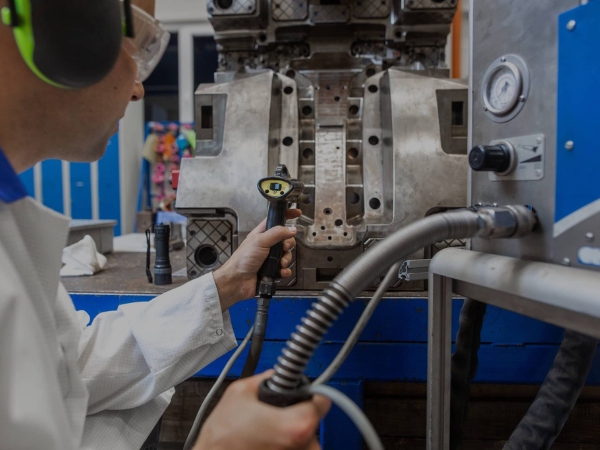
Plastic injection molding, also known as resin injection molding
Key characteristics:
- High precision with minimal tolerance.
- Smooth surface finish, requiring little post-processing.
- Fast production cycle, suitable for mass production.
- Excellent ability to reproduce small and complex geometries.
Practical applications:
- Electronic components: phone casings, electronic device housings.
- Automotive industry: technical plastic parts.
- Household goods: plastic boxes, daily-use tools.
- High-precision consumer products.
Overview of plastic casting method
Plastic casting is a forming process in which liquid or molten plastic material is poured or introduced into a mold, then left to cool naturally or with assistance until it solidifies into a finished product.
Compared to plastic injection molding, plastic casting is generally simpler and more flexible, especially for producing large-sized products or items with unique shapes.
Operating principle:
- Plastic is melted or used in liquid form.
- It is poured into a mold without high pressure (or with low pressure depending on the method).
- The cooling process allows the material to solidify and retain the mold’s shape.
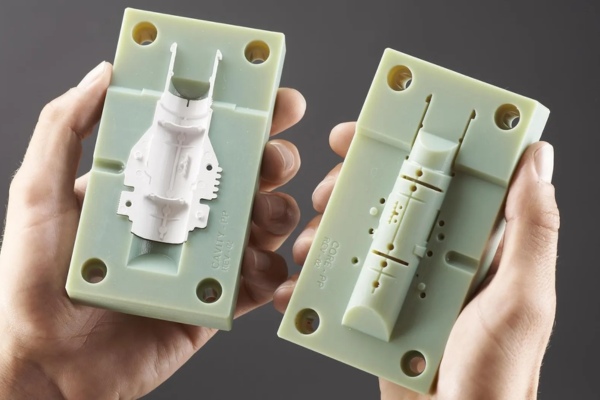
Plastic molding is a method of pouring liquid or molten plastic material into a mold
Key characteristics:
- Simple process with lower investment cost.
- Suitable for large-sized or hollow-structured products.
- Flexible mold design options.
- Lower precision and surface sharpness compared to plastic injection molding.
Practical applications:
- Plastic bottles, containers, and jerry cans.
- Industrial plastic tanks and storage containers.
- Toys and hollow 3D products.
- Some engineering polymer components or shoe soles.
Comparison of plastic injection molding and plastic casting: Core differences
Although both are common polymer forming methods in industrial manufacturing, plastic injection molding and plastic casting differ significantly in terms of process, precision, and investment cost. Understanding the nature of each technology helps businesses choose the most suitable solution for their products and production scale.
| Criteria | Plastic Injection Molding | Plastic Casting |
| Processing method | Molten plastic is injected into the mold under very high pressure using a screw system | Plastic is poured or placed into the mold under low pressure or without high pressure |
| Operating pressure | Very high | Low to medium |
| Product precision | Very high, low tolerance, suitable for technical parts | Medium, highly dependent on mold quality |
| Product characteristics | Solid parts, small components, complex geometries | Hollow products, large sizes, simpler structures |
| Surface quality | Smooth, high-quality finish, minimal post-processing | Depends on mold, may require additional finishing |
| Mold cost | High (steel molds, high precision requirements) | Low to medium |
| Equipment investment | High, complex machinery system | Lower, easier to implement |
| Production speed | Very fast, suitable for mass production | Moderate, slower than injection molding |
| Typical applications | Electronic components, automotive parts, high-end household goods | Plastic bottles, tanks, containers, toys, industrial bins |
Common materials used in plastic injection molding and plastic casting
In addition to selecting base polymer resins, both plastic injection molding and plastic casting processes often require supporting additives to achieve optimal performance and product quality.
Thermoplastic polymers and engineering plastics
In both plastic injection molding and plastic casting, thermoplastic polymers are widely used due to their ability to melt and reshape effectively. Common materials include:
- Polyethylene (PE): Flexible, good moisture resistance, commonly used for packaging, bottles, and containers.
- Polypropylene (PP): Lightweight, relatively heat-resistant, used in household goods and industrial components.
- Polyvinyl Chloride (PVC): High chemical resistance, widely used in pipes and construction materials.
These materials are highly versatile, cost-effective, and suitable for large-scale production.
Additives
In both plastic injection molding and plastic casting, additives play a crucial role in optimizing material properties and improving manufacturing efficiency. Depending on the application, manufacturers may incorporate different additive groups such as:
- Fillers
- Impact modifiers (toughening agents)
- Mold release agents (anti-sticking additives)
- Color masterbatches
- Plasticizers
- Heat stabilizers
These additives help polymers improve processability, enhance mechanical strength, increase thermal stability, and improve the aesthetic quality of finished products.
APEX Vietnam provides high-quality additives for the plastics industry
In an increasingly competitive plastics industry where both cost and quality are critical, choosing the right additive supplier is essential not only for production optimization but also for building long-term business advantages. APEX Vietnam positions itself as a provider of high-quality additives, meeting diverse requirements in both plastic injection molding and plastic casting.
APEX products are strictly quality-controlled to ensure strong compatibility with various polymer systems, helping manufacturers:
- Effectively reduce raw material costs.
- Increase product rigidity and improve mechanical properties.
- Stabilize dimensions and reduce shrinkage after processing.
- Enhance processing efficiency and reduce production defects.
- Improve whiteness and overall aesthetic quality of finished products.
With extensive experience and a stable supply capability, APEX Vietnam delivers comprehensive solutions for plastics manufacturers, effectively supporting both plastic injection molding and plastic casting technologies - from cost optimization to improved product quality. Contact APEX today for detailed consultation.